AI Made Coding Faster. Who Actually Banked the Time?
A June report says 97% of teams now use AI to write code and 92% got faster. Yet only a third actually bank the time they save. The difference comes down to something that sounds deeply boring.
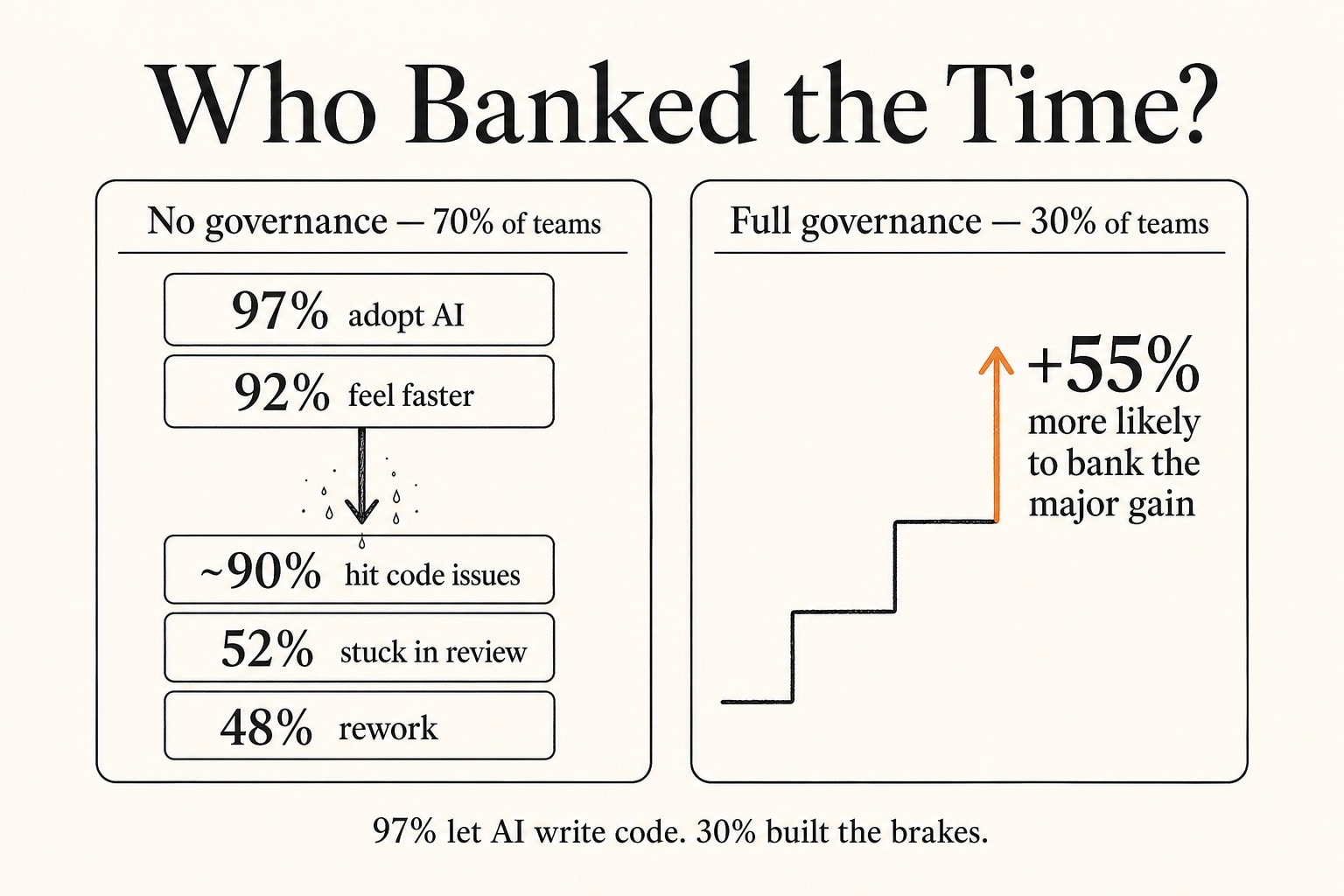
On June 9, a software security company called Black Duck published a report based on a survey of 831 engineers at large companies. The numbers read like an ad. 97% of development teams already use AI to write code, 92% say they got faster, and they reclaim about 8 hours a week on average. If the story stopped there, the takeaway would be simple: AI made building software cheap and fast, and everyone wins.
But the same report carries a second set of numbers. Nearly 90% of teams have hit problems with AI-generated code (it runs, but it hides bugs or security holes). More than half are stuck at the review step (where a person or a tool checks the code line by line for whether it is correct and safe), and 48% are stuck redoing work. So AI paved the writing stretch of the road, yet teams are not arriving any earlier. A lot of those 8 saved hours leak back out the side door.
Which leads to the most counterintuitive line in the report. Black Duck's CEO framed it bluntly: treating raw speed as an advantage, with no governance behind it, is really just stacking up a liability. Governance, in plain terms, means giving AI-written code a system of tracking and gatekeeping: who generated it, whether anyone reviewed it, whether you can trace a problem back to its source. It sounds like the kind of bureaucracy that slows you down. The data says the opposite. Only about a third of teams have that system fully in place, and it is exactly that third that is 55% more likely to report a major jump in efficiency.
Here is the same idea in a sentence a business owner can use. What AI really changed is the location of the bottleneck. Writing code was always the fast part. The slow part was always trusting that the code is right.
Think of AI as a new engine with three times the horsepower. A stronger engine does not guarantee you arrive sooner. If the brakes, the tires, and the road are unchanged, you either lose control on the curve or spend your saved time cleaning up the crash. The people who actually arrive earlier are the ones who upgraded the brakes and the road at the same time. Governance is that set of brakes.
Software has a term for this: technical debt (the shortcut you take today for speed, paid back later with interest, like a credit card). AI pushed the cost of writing code close to zero, so everyone is swiping harder. One figure in the report: more than half of respondents say their team's code volume grew by over 25%. The more code there is, the larger the surface you have to review, fix, and answer for. The cheaply generated part did not erase the bill. It just postponed it.
If you do not write code yourself, why does this report concern you? Quite a lot. When you want a small app, a website, an internal tool, the most tempting option today is to have AI (or a contractor using AI) generate it in an afternoon, at a price that feels unreal. That call is often right, and I make it myself. I only want you to ask one more question before you sign off: where are the brakes? Has anyone reviewed this code, who is accountable when it breaks, and is your data and your users' information actually locked away properly? Something generated in an afternoon, if it goes straight to taking real money from real users, can turn those 8 saved hours into a data breach or an outage that costs ten times more.
I build AI agents for a living (programs that read information, call tools, and run code on their own). When I start one, I set up the checking layer first and think about features second: which actions have to pass a gate, whether every step leaves a record, whether a mistake can be rolled back. I used to think this was just me being cautious. After this report, I understand it differently. That checking layer is the 55% gap itself.
AI makes writing code faster. That is real, and the saved time is real. Whether you get to keep that time in your pocket comes down to something far less exciting: whether you also built the thing that catches the mistakes. The speed is handed to you for free. Keeping it is the part you have to pay for.