Felt 20% Faster, Measured 19% Slower: Most People Are Doing the AI-Coding Math Wrong
In a randomized controlled trial, senior developers using AI to code felt 20% faster and were measured 19% slower. The problem isn't AI — it's that most people never measure it, and you can't manage what you don't measure.
Hacker News in 2026 reads differently than it did a year ago. A year ago the front page was wall-to-wall "AI is going to replace programmers." This year the top threads are doing a different kind of math: once you count the hidden costs — review, rework, maintenance, the debugging after something breaks — is AI coding actually shipping faster? The hype has left the room and the ledger has walked in. That's progress.
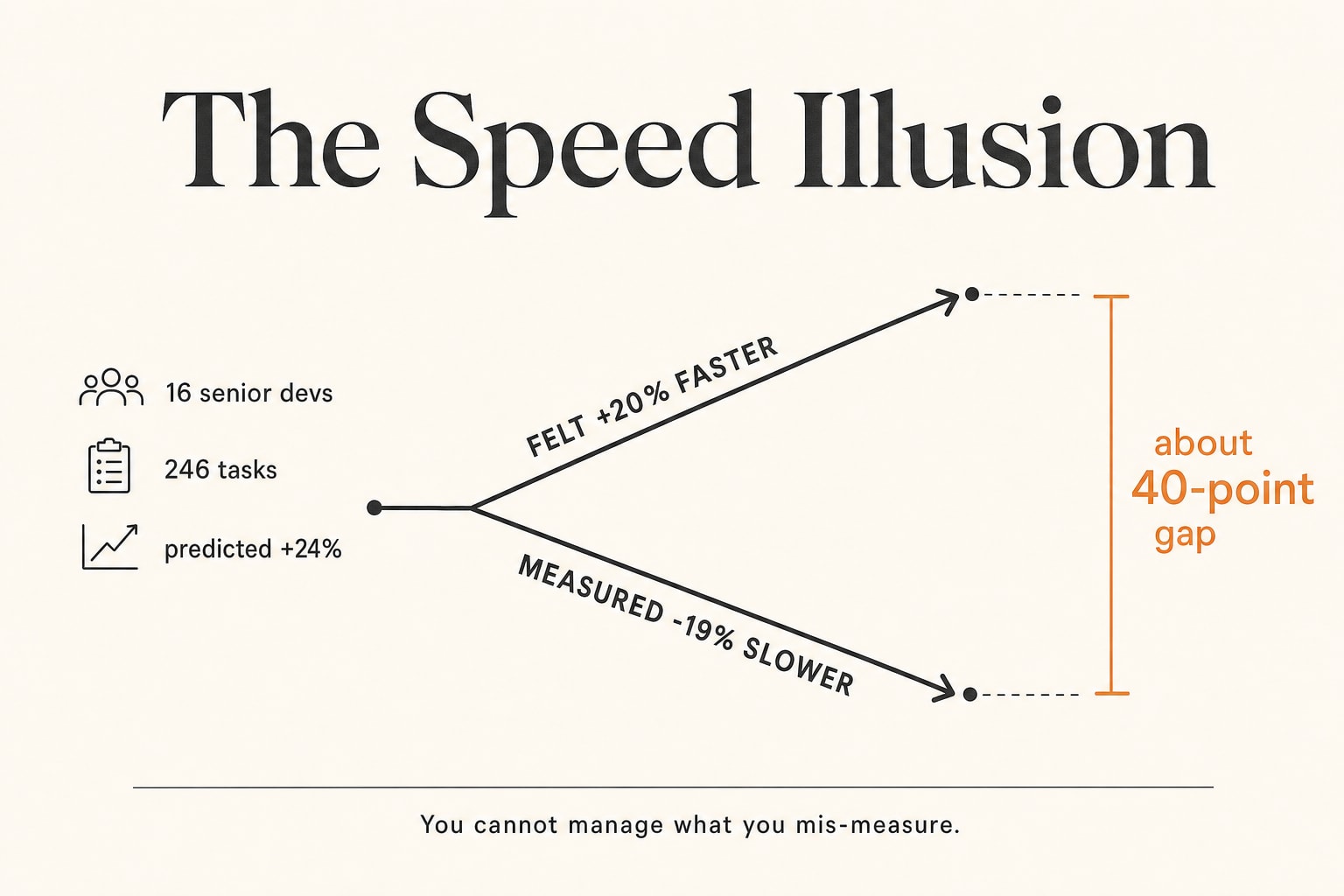
Let me put the one number worth remembering on the table. In 2025, an independent research outfit called METR ran a randomized controlled trial (the gold-standard method from medicine — randomly split the work into two groups, one allowed to use AI and one not, then compare). They took 16 experienced open-source developers and had them work 246 real tasks inside large projects they had maintained for years, codebases over a million lines. Before starting, these developers predicted AI would save them 24% of their time. After finishing, their gut said "AI made me about 20% faster." The measured result: they were 19% slower.
Sit with those three numbers. Predicted 24% faster, felt 20% faster, actually 19% slower. The scary part isn't the 19% drag. It's the roughly 40-point gap between perception and reality — people slowing down while sincerely believing they were speeding up.
A lot of readers see that headline and want to shout "see, AI is useless." That's a misread — and the kind of misread that makes you decide wrong. The study's design hides a crucial limit: the subjects were senior people who knew their own code cold, working in their own mature projects. That is precisely the scenario where AI should be expected to help least.
Because in code you could write blindfolded, your bottleneck was never typing speed — it's the map already in your head. The solution took shape in your mind long ago; typing it out is just finger speed. Now hand it to an AI first, and you have to read its version, understand it, catch its mistakes, and bend it back into what you already wanted. That whole review-and-rework loop is a tax bolted on from nowhere. The AI didn't let you skip the thinking; it added a proofreading exam.
So when does AI actually speed you up? The answer is the mirror image of the same mechanism: the wider the knowledge gap between you and the code, the more AI is worth. An unfamiliar stack, a framework you've never touched, a greenfield prototype, the boilerplate nobody wants to hand-write — in those cases you were already going to grind through docs, trial, and error, and AI compresses exactly that miserable stretch. The bigger the gap, the more it saves; the smaller the gap, the more it gets in your way.
Translate that into one sentence for a boss or an investor: the return on AI coding doesn't hinge on how strong the model is — it hinges on which end of the knowledge gap you point it at. Put your most senior people, the ones who know the system best, on AI inside the modules they know cold, then wonder why nothing got faster — you bet on the wrong end. The work that should go to AI is the newcomer picking up an unfamiliar module, the exploration into territory no one has mapped, the throwaway validation. Same tool: in the right place, an accelerator; in the wrong place, a cognitive tax.
But the thing I actually want you to walk away with isn't "where to point AI." It's that 40-point gap itself.
It tells you something: on the question of whether you got faster, human intuition is not to be trusted. These weren't novices or outsiders — they were the single most fluent person on each project, and as a group they got the direction backwards. The people on your team are no different. They'll sincerely tell you AI made them a lot faster, and that sentence may be off from reality by nearly 40 points. If your AI strategy rests on "everyone says it's way faster," you're making a major investment decision with an instrument that can't measure straight.
I ship with AI every day, and I never trust the words "felt faster." I watch cycle time (how long it actually took from start to delivery), not how good it felt. That's not distrust of AI — it's because I lean on it so heavily that I refuse to let a feeling stand in for a measurement. METR knows the question isn't settled either; in early 2026 they were still publicly redesigning this experiment to keep testing it. When even the research lab is still recalibrating, and companies sign off on "feels way faster," that contrast is itself the answer.
Whether AI makes coding faster is a real question. But the question that matters more is: are you measuring it? If you don't, all you have to bet on is the feeling — and this trial already told you the feeling lies, even the experts' feeling lies.