You Installed Seven AI Tools. The Work Got Slower.
A report says designers' AI toolstack jumped from 3 to 7 in a year, yet half still hunt for a go-to tool. The magic lives in the ten-second generation; the time disappears in the seams between tools.
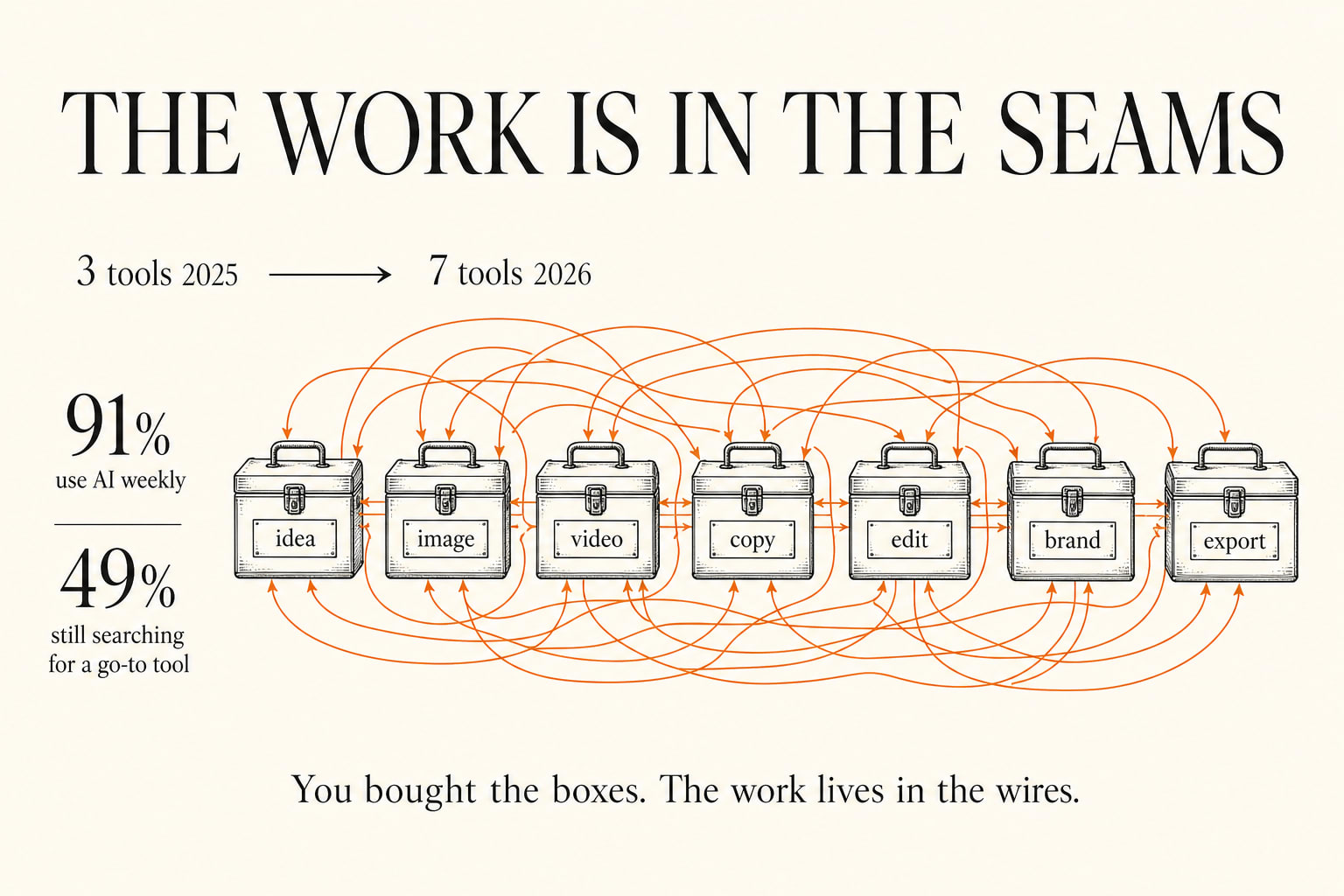
Here is a number worth watching. The State of AI in Design Report 2026 says the average designer's AI toolstack more than doubled in a year, from 3 tools to 7. In the same report, 91% now use AI in their work at least weekly, up from 54% a year ago. It reads like a bumper harvest. Yet among that same crowd, almost half (49%) say they're still hunting for their go-to tool.
The toolstack doubled and the certainty dropped. That's worth sitting with.
Every AI tool launches with the same scene. You type a sentence, and ten seconds later out comes a poster, a video clip, a paragraph of copy. The scene is beautiful, and it's real. The catch is that those ten seconds are only the opening of the job. On an actual project, the other ninety percent of the time goes elsewhere: feeding tool A's output into tool B, fixing formats, matching brand tone, stitching scattered pieces into something you can actually hand off, then circling back to check the thing didn't confidently invent a number that doesn't exist.
I call that part the seams, the connective stretch between one tool and the next. That "can't find my main tool" confusion in the report traces straight back here. Each tool you add shortens those ten seconds of generation. What it lengthens is a brand-new set of seams between this tool and the six you already had. The generation work keeps shrinking while the seam work keeps growing. Run the math and two tools can beat seven; the extra five mostly add fresh places to miss an error. A June piece on enterprises put it plainly: a content team running six AI tools with no verification step multiplies its exposure to compounding errors, brand drift, and fabrication just as fast as it multiplies its output.
The sneakier trap is that "still searching for the main tool" itch. Plenty of people blame low output on "haven't found the right tool yet," so they keep switching. But every switch voids the seams you'd built and you reassemble from scratch. The searching itself is the pit: no single tool covers the whole job end to end, so the hunt never finishes. You feel like you're upgrading while you're resetting in place.
So what actually compounds? The seams themselves. The pipeline you slowly build around two or three tools you stop swapping: where material enters, who owns brand consistency, which step needs a human's eyes, how the output gets stored. None of that shows up in any tool's ad. It grows in your own hands. Building products feels the same to me: shipping something real is maybe ten percent the act of generating and ninety percent the connective work of making every stage flow and run again and again.
So if you're the owner, the founder, the person signing off on tools for a team, here's a call you can use today. Don't get sold by the demo. Judge an AI tool less by how dazzling its ten-second magic looks and more by how cheaply it plugs into what you already do. The shorter the seam, the more it's worth.
Concretely: freeze your stack. Pick two or three tools that cover the main stages, stop chasing the new ones, and pour the saved energy into the pipeline between them. A year from now, that peer who looks six times faster than you probably holds fewer tools than you do. They locked their count early and spent all their effort on the seams. Tools will keep arriving, each one showing you that same ten-second scene. What actually makes you fast is whether you built the backstage after the scene ends.